
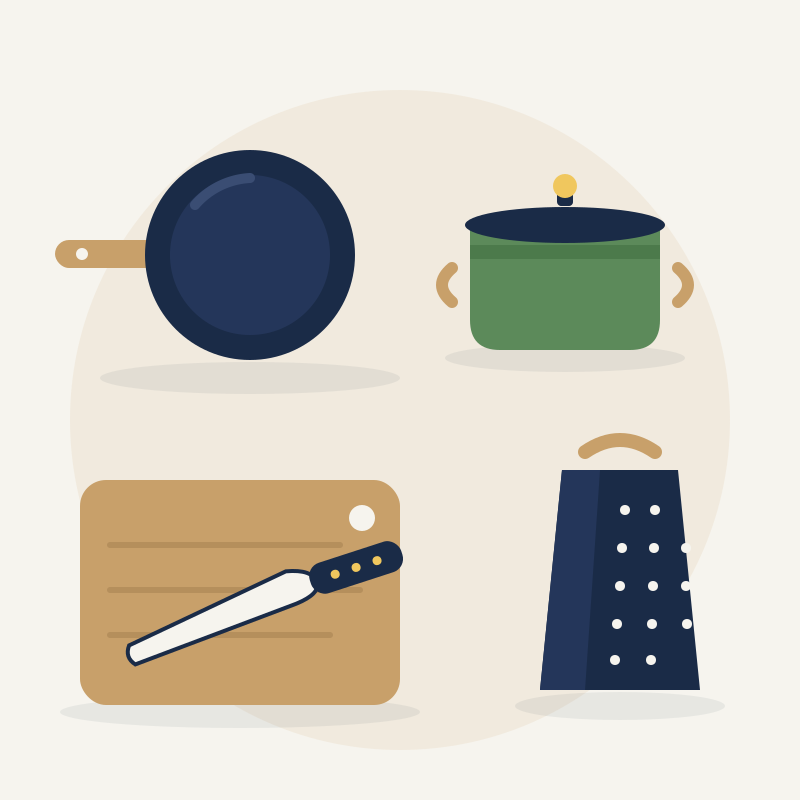
In our guide to kitchen gadgets for small apartments we promised to take minimalism to its logical end — and here it is. This is the minimalist kitchen tools challenge: five well-chosen tools that genuinely replace twenty single-purpose gadgets. Not as a stunt, but because this is roughly how professional cooks work: fewer tools, better ones, always within reach. If your drawer currently fights back when you open it, this article is your exit plan.
The Minimalist Kitchen Tools Challenge: Why 5 Beats 25
Every gadget in your kitchen has a hidden cost: the space it occupies, the cleaning it demands, and the seconds you spend digging past it to reach what you actually need. Twenty mediocre tools make cooking slower, not faster.
There’s also a simple test that makes the case better than any argument. Open your most crowded drawer and sort everything into two piles: “used this week” and “the rest”. For most households, the first pile holds four or five items — and they’re almost always versions of the five tools below. Your own kitchen has already voted; this article just counts the ballots.
The five below aren’t random. Each one is a “platform” — a tool so versatile that entire shelves of gadgets exist just to do small slices of its job, slightly worse. Master these five and the other twenty become answers to a question nobody asked.
The Five Minimalist Kitchen Tools (and What Each One Replaces)
1. A 20 cm chef’s knife — replaces 7 gadgets. Garlic press, herb scissors, vegetable chopper, avocado slicer, apple corer, egg slicer, pizza cutter. Every one of these is a chef’s knife with training wheels. A sharp knife minces garlic in ten seconds and slices pizza better than the wheel (steadier, no dragged toppings). Ten minutes of practice pays back for life.
2. A large wooden cutting board — replaces 3. Serving platter, cheese board, and trivet for hot pots. Buy one big enough that food doesn’t escape over the edges — roughly 40×30 cm. Bigger board, calmer cooking.
3. A cast-iron or heavy stainless skillet — replaces 5. Grill pan, sandwich press, crêpe pan, roasting tin (it goes straight into the oven), and a wok for most home stir-fries. Cast iron heats evenly, sears properly, and outlives its owner — one honest pan instead of a tower of coated ones.
4. A large heavy pot with a lid — replaces 4. Pasta pot, steamer (a folding basket drops inside), rice cooker, and casserole dish. Soups, stews, boiling, braising, even baking bread if it’s oven-proof. If you buy only one expensive thing, make it this or the skillet.
5. A box grater — replaces 3. Zester (the fine side), cheese slicer, and mandoline for everyday jobs. Four sides, four textures, zero electricity, cleans in thirty seconds.
The scoreboard: 5 tools in, 22 gadgets out. We promised twenty; you get two extra for free.
What You’re Allowed to Keep
Minimalism isn’t a punishment, so three honest exceptions survive every purge: a can opener and a corkscrew (no substitutes exist) and a wooden spoon or silicone spatula for stirring. If you cook daily for a family, our small-apartments guide makes the case for an immersion blender as a worthy sixth slot — it replaces appliances, not gadgets, which is a different battle.
Everything else should earn its way back in. The rule from our zero-waste kitchen guide applies here too: an item that hasn’t been touched in six months isn’t equipment, it’s clutter with sentimental immunity.
How to Buy Minimalist Kitchen Tools That Last
When five tools do all the work, quality matters more than usual — but that doesn’t mean expensive:
- Knife: a solid starter chef’s knife costs €20–35. Spend the savings on a €10 sharpening stone; a sharp cheap knife beats a dull premium one every single day.
- Skillet: plain cast iron is famously cheap (€25–45) precisely because there’s no coating technology to pay for. It’s also the honest choice — no non-stick layer to degrade and replace every two years, a point equipment testers at America’s Test Kitchen make repeatedly.
- Pot: enamelled or stainless, 4–6 litres, the heaviest lid you can find. Supermarket own brands are often fine; thin bases are the only real deal-breaker.
- Board and grater: €10–15 each. Wood over plastic for the board — kinder to your knife edge and to the planet.
Total for all five, bought sensibly: €90–120 — less than one mid-range food processor, with nothing left to break.
FAQ: Minimalist Kitchen Tools
Can 5 minimalist kitchen tools really cover baking too? Mostly, yes: the pot bakes bread, the skillet handles crumbles, tarts and cornbread. Dedicated bakers will want a baking sheet and one cake tin — that’s an honest 7-tool kitchen, still far from 25.
What’s the first gadget to get rid of? The garlic press. It’s the mascot of single-purpose clutter: harder to clean than the ten seconds of knife work it saves.
Isn’t cast iron hard to maintain? Less than its reputation says: wash, dry, wipe with a drop of oil. That’s the whole ritual — easier than hand-washing a “dishwasher-safe” non-stick pan you’re afraid to scratch.
Do minimalist kitchen tools save money overall? Noticeably. Five durable tools at €90–120 replace €200+ of gadgets that wear out and get rebought. Fewer, better, once.
Ready to try the challenge? Our Kitchen collection is built around exactly this philosophy — multi-use tools that earn their place — and you can sign up on our homepage to get 10% off at launch. 🍳